


It’s the middle of August. The forecast calls for another hot afternoon, employees are arriving for work, customers will be walking through the doors soon and somewhere inside the building, the air conditioning has stopped working.
At first, it might not seem like an emergency. The building is still cool from the night before. The lights are on. Business can continue.
But the clock is ticking..png?width=495&height=619&name=80%20degree%20hot%20tent%20graphic%20(1).png)
8:03 AM: Someone Notices It’s Getting Warm
The first sign of an HVAC failure often isn’t dramatic. Someone notices the building feels a little warmer than usual. An employee adjusts the thermostat. Nothing happens.
Maybe maintenance gets a call. Maybe everyone assumes the system just needs a few minutes to catch up.
Meanwhile, outside temperatures are rising, people are entering the building, equipment is running and heat is beginning to accumulate indoors.
9:15 AM: “Is It Hot in Here?”
Now people are noticing.
In an office, employees might bring out desk fans. In a retail store, customers may spend less time browsing. Inside a restaurant, the kitchen, already battling heat from ovens, grills, fryers and dishwashers, can become uncomfortable remarkably quickly.
The HVAC problem has officially become an operations problem.
10:30 AM: Indoor Temperatures Keep Climbing
Without adequate cooling, heat generated inside a building has nowhere to go.
Machinery, computers, lighting, cooking equipment and even people contribute to the heat load. Large windows and direct sunlight can make conditions worse.
And the consequences depend heavily on the type of business.
In an office, heat can affect concentration, productivity and employee comfort.
In retail, customers have an easy solution: leave. An uncomfortable store can mean shorter visits and lost sales.
In a factory or manufacturing facility, the stakes may be higher. Excessive heat can affect workers, machinery and processes that depend on specific temperature conditions.
In a warehouse, temperature-sensitive inventory may become a concern, especially when extreme outdoor temperatures combine with large spaces that are difficult to cool.
12:00 PM: It’s Not Just About Comfort Anymore
By midday, the question may have shifted from “When will the AC be fixed?” to “How long can we safely keep operating?”
For restaurants, an HVAC outage can be particularly difficult. Commercial kitchens generate enormous amounts of heat even when the building’s cooling system is functioning normally. Add an HVAC failure on a hot summer day, and working conditions can deteriorate quickly.
Businesses may also need to consider temperature-sensitive products, refrigeration equipment and other systems operating in an increasingly hot environment.
Factories and industrial facilities face their own challenges. Heat can affect employees working physically demanding jobs while also creating concerns around equipment and manufacturing processes.
And all the while, the outdoor temperature may still be climbing.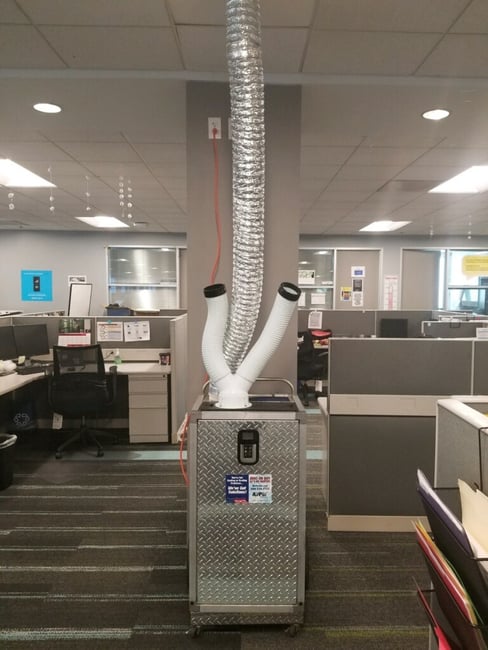
2:00 PM: Stay Open or Shut Down?
Now management has a decision to make.
Can employees continue working? Are customers comfortable? Is equipment operating properly? Are products or processes at risk? How long will permanent HVAC repairs take?
An HVAC technician might be able to fix the problem that afternoon. But a major compressor failure, replacement part delay or larger system issue could mean days, or longer, without normal cooling.
Closing may seem like the only option.
It doesn’t always have to be.
The Backup Plan: Temporary Cooling
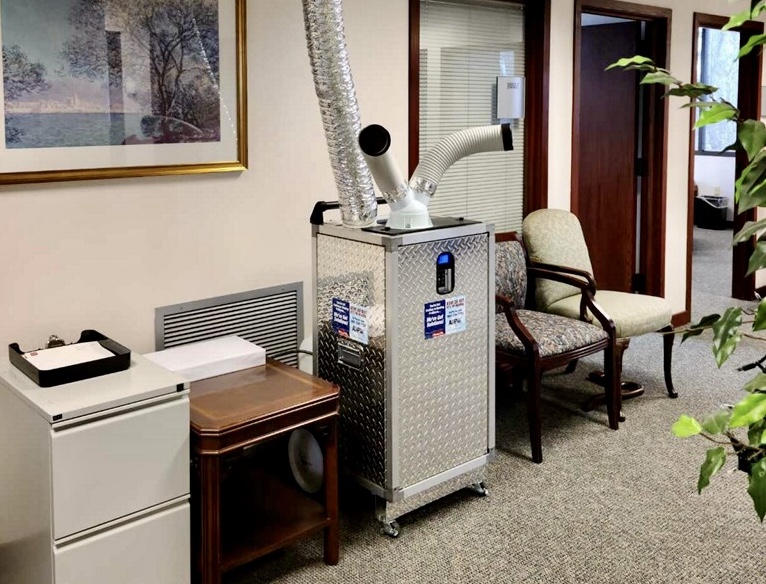
Temporary and portable air conditioning can bridge the gap between HVAC failure and permanent repair.
Depending on the facility, temporary cooling equipment can be used to cool critical production areas, kitchens, workspaces, customer-facing areas, equipment rooms or larger sections of a building. That allows businesses to focus cooling where it matters most while their permanent system is repaired or replaced.
The key is responding before indoor conditions become critical.
At AirPac, we provide temporary and portable cooling solutions for commercial and industrial facilities facing planned and unexpected HVAC downtime. From restaurants and retail spaces to warehouses, factories and offices, temporary cooling can help businesses protect their people, products and operations when their primary cooling system can’t.
Because when the AC goes out in August, the real question isn’t simply how quickly it can be repaired.
It’s how long your business can afford to wait.